
Traditional Retrieval Is Breaking Enterprise AI.
This new retrieval framework organizes knowledge the way your company already does, and the accuracy gains are hard to ignore.

Most retrieval-augmented generation setups work the same way:
Every chunk of text sits in the same flat pile. When a user asks a question, the system grabs the chunks that look closest by keyword or embedding similarity, stuffs them into a prompt, and hopes the language model produces something accurate.
For a weekend chatbot project, this works fine.
But for enterprise use cases where a wrong answer triggers a compliance violation, a misquoted policy, or a hallucinated contract clause, flat retrieval is a structural liability.
The retrieval layer is not failing because the model is bad. The retrieval layer is failing because it has no concept of how information relates to other information.
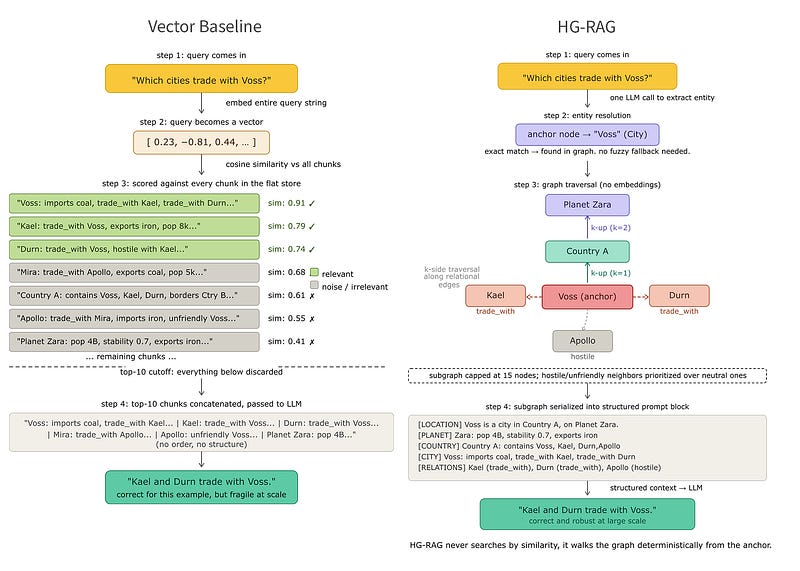
A framework called Hierarchy-Guided Retrieval-Augmented Generation (HG-RAG) addresses this by organizing documents into a tree-like structure before retrieval ever begins. Instead of treating a 200-page compliance manual as 400 disconnected text blocks, HG-RAG preserves the parent-child relationships between sections, subsections, and clauses. The retrieval step then walks the hierarchy, pulling context that respects the document’s own logic.
What HG-RAG Does Differently
Think of flat retrieval like searching a bookstore where every page from every book has been ripped out and scattered across one long table. You can find pages that mention your search term, but you lose the chapter, the book, and the shelf that gave each page meaning.
HG-RAG rebuilds the bookstore. It constructs a hierarchy from source documents, mapping how a top-level policy connects to its sub-policies, how a product spec connects to its feature requirements, how a legal contract connects to its amendment clauses. When the system retrieves context for a query, it does not grab isolated chunks.
It walks the tree: starting at the most relevant node, then pulling the parent context above it and the sibling context beside it.
This means a question about “termination rights in Section 4.2” returns not only the text of 4.2 but also the definitions from Section 1 and the governing-law clause from Section 12 that controls how 4.2 gets interpreted. Flat retrieval would return 4.2 and three unrelated paragraphs that happened to mention the word “termination.”
The accuracy gains in compliance-heavy domains are substantial. Hierarchical retrieval reduces hallucination rates by preserving the logical relationships that flat chunking destroys.
What This Changes for Your Roadmap
The implication for anyone building an AI product on top of enterprise documents is direct:
Your retrieval architecture is a product decision, not an infrastructure detail.
I have watched teams spend months fine-tuning their language model to reduce hallucinations when the root cause was never the model. The root cause was the retrieval layer handing the model contradictory chunks from different sections of the same document. No amount of prompt engineering fixes the context that arrives broken.
HG-RAG forces a different investment. You spend time upfront building or extracting document hierarchies. For regulated industries like finance, healthcare, and insurance, this hierarchy already exists in the documents themselves. Section numbers, nested clauses, and amendment structures. The information architecture is sitting there. Most RAG pipelines ignore it.
RAG architecture choices now carry as much weight as model selection. The retrieval pattern you pick determines what the model sees, and what the model sees determines what the model says.
For product and engineering leads, the “so what” breaks into three decisions:
Document ingestion pipelines need hierarchy extraction. If you are chunking PDFs by token count without preserving section structure, you are discarding the most useful signal in the document. Parsing sections, headers, and nesting depth is an upfront cost that pays back on every query.
Retrieval scoring needs structural weight. A chunk’s relevance score should account for its position in the hierarchy, not only its semantic similarity to the query. A definition clause at the top of a contract is relevant to every question about that contract, even if it shares zero keywords with the query.
Compliance and audit trails get easier. When retrieval respects document structure, you can trace every generated answer back to a specific section, subsection, and clause. Flat retrieval produces answers sourced from fragments. Hierarchical retrieval produces answers sourced from locations. The difference matters the moment a regulator asks “where did your system get this?”
What the Research Doesn’t Cover
The honest gap with HG-RAG sits in three places.
First, the framework assumes documents have a clean hierarchy to extract. Many enterprise documents do: legal contracts, regulatory filings, technical specifications. But a large share of enterprise knowledge lives in Slack threads, email chains, wiki pages with inconsistent formatting, and meeting transcripts with no structure at all. HG-RAG’s advantage disappears when the source material is flat by nature, not by engineering choice.
Second, hierarchy extraction at scale is its own engineering problem. Parsing section numbers from a well-formatted PDF is straightforward. Parsing the implicit hierarchy of a 90-page internal wiki with inconsistent headings, embedded tables, and inline images is not. The research demonstrates the value of hierarchy once you have it. The cost of building that hierarchy across thousands of heterogeneous documents is a separate, unsolved problem for most teams.
Third, the performance benchmarks come from controlled document sets. Production environments involve documents that change weekly, version conflicts across regional offices, and source material in multiple languages. The hierarchical index needs to stay current as documents evolve. Stale hierarchies produce the same broken context that flat retrieval does, with higher confidence, which is worse.
None of these gaps invalidates the core finding. Hierarchy-aware retrieval produces better context than flat retrieval in structured documents. That result holds.
The Bet Worth Making
The teams that will get enterprise AI accuracy right over the next two years are not the ones picking the best language model. They are the ones building retrieval layers that respect how their documents are organized.
Flat retrieval was the default because it was the easiest to build. HG-RAG is harder to set up and requires upfront investment in document parsing, hierarchy extraction, and structural indexing. That investment is the moat. Every competitor using the same LLM with flat retrieval will produce worse answers on the same documents.
The question is not whether hierarchical retrieval is better. The question is whether your documents are structured enough to benefit from it, and whether your team is willing to do the parsing work before writing a single prompt.
Context Window is a 100% free, reader-supported publication. Every deep-dive takes hours of analyzing market trends, reading complex whitepapers, and translating raw AI developments into actionable product strategies.
Your contribution goes directly toward maintaining this space and funding the deep research required to separate the signal from the noise. If my blogs have helped you ship a better product, rethink a framework, or simply see the AI landscape a bit more clearly, your support means the world.