

Every team building on large language models faces the same quiet risk. Training data, fine-tuning datasets, retrieval-augmented generation inputs, and user prompts all carry personally identifiable information (PII), meaning names, emails, phone numbers, addresses, and health records that belong to real people.
The moment that data enters a model pipeline without protection, it becomes a liability. Not a theoretical one. A legal and reputational one, with fines measured in millions and trust measured in years to rebuild.
I have spent enough time building AI-powered products to know that the default state of most LLM pipelines is leaky.
The data flows fast. The pressure to ship is high. And the PII protection conversation gets postponed until someone from legal sends a panicked Slack message.
We are going to talk about 5 core anonymization techniques that exist to close these gaps before they become incidents: data masking, pseudonymization, generalization, data swapping, and synthetic data generation.
The question is not whether your pipeline needs them. The question is where, and in what combination.
How PII Enters Your Pipeline (and Where It Escapes)
Most engineers picture PII risk as a single point of failure. It is not. PII enters an LLM pipeline at multiple stages, and each stage has a different exposure profile.
The first entry point is training data. If your model was fine-tuned on customer support transcripts, product reviews, or internal documents, those datasets contain PII that the model can memorize and reproduce.
The second entry point is the prompt itself. Users type their names, account numbers, and medical symptoms directly into the input field.
The third is retrieval-augmented generation (RAG), where your system pulls from a knowledge base that contains unredacted source documents.
Each of these stages creates a different kind of leak. Training data memorization means the model can regurgitate a real person’s information in response to an unrelated query. Prompt leakage means another user’s session, or a log file, captures PII in plaintext. RAG leakage means your retrieval layer surfaces a document with sensitive fields intact.
Think of it like a building with three unlocked doors. Locking one does not secure the other two. And most teams lock only the front door (training data), while the side entrances (prompts and RAG) stay wide open.
Five Techniques That Close the Gaps
The fix is not one technique. It is a layered approach where each method covers a different failure mode.
Data masking replaces sensitive values with non-sensitive equivalents. A Social Security number becomes XXX-XX-1234. The format stays intact, but the real value disappears. Format-preserving masking is the version that matters for LLM pipelines because it keeps the data structure consistent for downstream processing without exposing the original.
Pseudonymization swaps real identifiers with fake but consistent tokens. “Jane Doe” becomes “User_7832” across every record. The mapping between real and fake lives in a separate, secured lookup table. If someone breaches the pipeline, they get tokens. Without the lookup table, those tokens mean nothing.
Generalization reduces precision. An exact age of 34 becomes “30–40.” A street address becomes a zip code. The data remains useful for pattern analysis without pointing to a specific person.
Data swapping shuffles values across records. The name from record A gets paired with the address from record B. Individual records become meaningless even though aggregate patterns hold.
Synthetic data generation creates fake records that mirror the statistical properties of real data without containing any real person’s information. For training and testing LLM features, synthetic data removes PII risk at the source.
The right combination depends on the stage.
Masking and pseudonymization work best at the prompt and RAG layers.
Synthetic data and generalization work best at the training layer. No single technique covers all three doors.
Responsible pipelines layer multiple techniques with automated PII detection scanning inputs before they reach the model.
Governance Is Not a Layer You Add Later
Techniques without governance are tools without a toolbox. I have seen teams implement pseudonymization at the prompt layer and feel protected, while their RAG knowledge base served unredacted medical records on the back end.
The technique worked. The governance did not exist.
A governance framework for LLM pipelines covers four functions.
First, automated PII detection at every ingestion point, not one.
Second, role-based access controls that determine who can see raw data versus anonymized data.
Third, audit logging that records what data entered the pipeline, what anonymization was applied, and when.
Fourth, compliance mapping that ties each anonymization decision to the specific regulation it satisfies, whether that is GDPR, HIPAA, CCPA, or a sector-specific rule.
The practical benefit is not abstract. When a regulator asks “how do you protect PII in your AI system,” the answer needs to be a documented, auditable chain of decisions.
Not a slide deck. Not a verbal explanation from the engineer who set it up two years ago.
I treat governance as infrastructure, the same way I treat monitoring or CI/CD. It is not a feature. It is a prerequisite for operating in production.
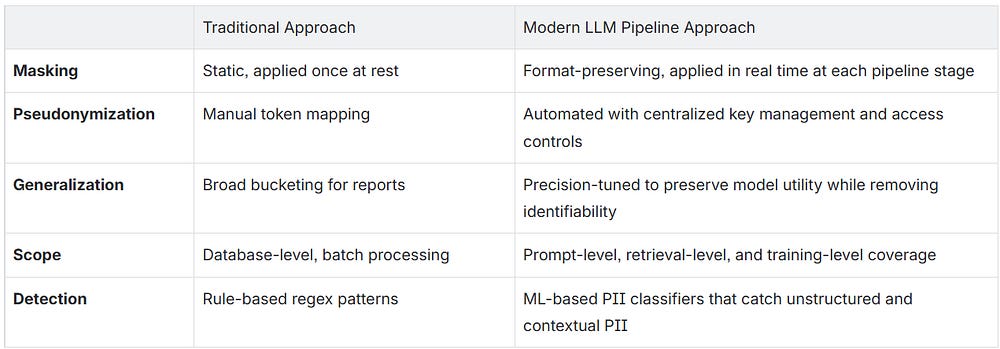
Traditional Anonymization Is Not Enough for LLMs
Here is the part most teams underestimate. LLMs create a category of PII risk that traditional anonymization was never designed to handle.
Traditional masking was built for structured databases. A column labeled “SSN” gets masked. A column labeled “name” gets pseudonymized.
The rules are field-level.
LLM pipelines process unstructured text where PII can appear anywhere, in any format, embedded in a sentence that a regex pattern will miss. A user writes “my doctor, Sarah Chen at Mount Sinai, prescribed me” and a field-level masking rule sees none of it.
The second gap is re-identification. Even when PII is removed, LLMs can infer identity from combinations of non-PII attributes. A zip code, an age range, and a job title, none of which qualifies as PII individually, can narrow down to a single person. Generalization helps, but only if the granularity is tuned with this re-identification risk in mind.
The third gap is model memorization. Anonymizing inputs does not erase what the model learned during training. If the base model or your fine-tuned version memorized PII from its training corpus, that data can surface in outputs regardless of what you do at the prompt layer.
Engineers building on LLMs need to hold two truths at the same time:
Anonymization techniques are necessary, and they are not sufficient.
The sufficient answer is anonymization plus governance plus continuous auditing plus an honest assessment of what your specific pipeline’s exposure surface looks like.
The teams that get this right are the ones that treat PII protection the way they treat uptime. Not as a project with a finish line, but as an operational discipline that runs every day the system is live.
Context Window is a 100% free, reader-supported publication. Every deep-dive takes hours of analyzing market trends, reading complex whitepapers, and translating raw AI developments into actionable product strategies.
Your contribution goes directly toward maintaining this space and funding the deep research required to separate the signal from the noise. If my blogs have helped you ship a better product, rethink a framework, or simply see the AI landscape a bit more clearly, your support means the world.